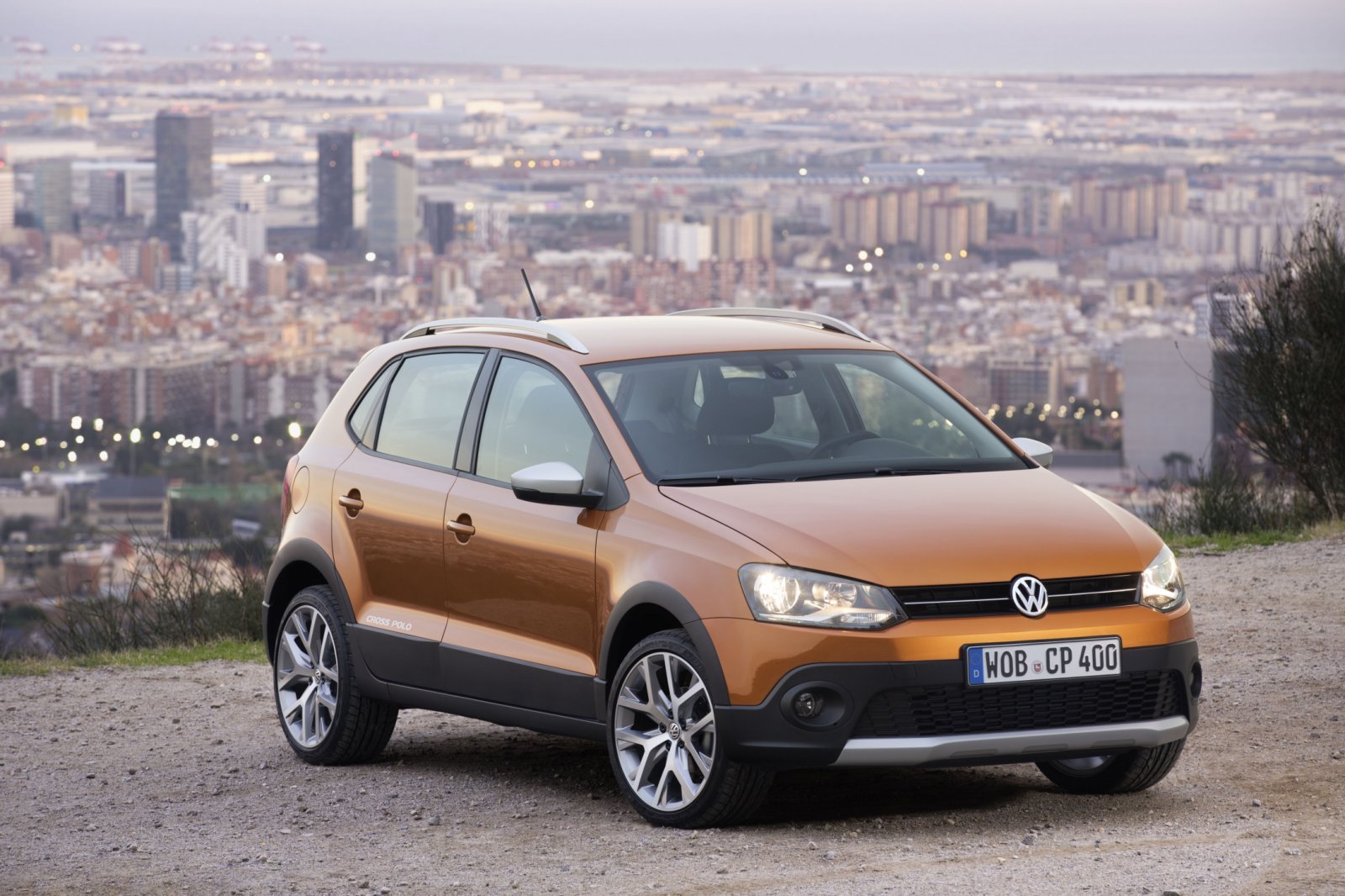
We take like base a VW Polo 1.2
- Fuel consumption (town) 5.8 L/100km
- Fuel consumption (highway) 4.1 L/100km
- Average fuel consumption 4.7 L/100km
- Engine Power kW 81 kW
- Average trip with full tank 1125 km (703 miles)
- Weight 1163 kg
We need to compare with fossils fuels, mainly isoctane (petrol) that have 11,778 Wh/kg; 42.4 MJ/kg. but in this case we set efficiency around 30%.
Internal Combustion Engine
| |||
Pretol
|
Energy
|
42.4 MJ/kg
| |
Density
|
0.748kg/L
| ||
η
|
30.00%
| ||
Consumption each 100 kms
|
4.10 L
|
100 kms
| |
3.06 kg
| |||
Energy Consumption 100 kms (EPetrol)
|
129.9 MJ
| ||
Energy used in 100 kms
|
39.0 MJ
| ||
If we suppose 1,125 kms with constant speed without energy recovery possibility, we need (39MJ/100kms x 11.25kms) 438.56 MJ to move the car this distance and we could use this value like standard.
Batteries technologies
BATTERIES
| ||||
TECHNOLOGIES
|
MIN
|
MAX
| ||
Lead
|
30 Wh/kg
|
108 kJ/kg
|
40 Wh/kg
|
144 kJ/kg
|
Ni-Fe
|
30 Wh/kg
|
108 kJ/kg
|
55 Wh/kg
|
198 kJ/kg
|
Ni-Cd
|
48 Wh/kg
|
173 kJ/kg
|
80 Wh/kg
|
288 kJ/kg
|
Ni-Mh
|
60 Wh/kg
|
216 kJ/kg
|
120 Wh/kg
|
432 kJ/kg
|
Li-ion
|
110 Wh/kg
|
396 kJ/kg
|
160 Wh/kg
|
576 kJ/kg
|
Li-Po
|
100 Wh/kg
|
360 kJ/kg
|
130 Wh/kg
|
468 kJ/kg
|
Ultra Capacitor
|
7 Wh/kg
|
27 kJ/kg
|
7 Wh/kg
|
27 kJ/kg
|
Fuel Cell
|
14,400 Wh/kg
|
51,840 kJ/kg
|
33,333 Wh/kg
|
120,000 kJ/kg
|
If we take the best current batteries technology, it is the Li ion and for use the 438.56 MJ we need 761.4 kg. This is the weight of current Polo.
Second problem is the mean life of batteries the batteries life is around 200 cycles of 2.5 years, (guarantee power > 90%). Several test show that the life is 8 years, and one packet batteries is $8,000-$12,000.
The other problem is the manipulation conditions, the voltages maximum should not exceed 50-60V. Several regulations and mechanics without experience with high voltage electrical systems, we should think in secure manipulation for this workers.
Making numbers
Our model of Engine Power is 81 kW with 50-60V we need 1,620-1,350 A and the maximum power.
In the 1,125kms, if we suppose the constant speed 100km/h is 11.25h or 675 min or 40500 s, therefore if we use 438.56 MJ, the engine should provide 10.8 kW meanwhile we keep constant speed. 10.8 kW with 50-60V we need 217-180 A.
The losses in electric system mainly is heat losses to internal resistance:

The internal resistance of one cell is near of 0.03 ohms.
Range
|
1125 kms
| |
438,6 MJ
| ||
Average Speed
|
100,0 km/h
| |
Time
|
40500 s
| |
Power for 100 km/h
|
10,8 kW
| |
Voltage
|
50,0 V
|
60,0 V
|
Current
|
217 A
|
180 A
|
Internal resistance
|
0,03 Ω
| |
Internal losses
|
1,41 kW
|
0,98 kW
|
12,99%
|
9,02%
| |
Everybody have contact with this fact, for example when we charge or use laptops, tablet, mobiles or smartphones... any PED (Portable Electronic Device) with batteries, we feel how it is heated, hence we can think, that cell packs need refrigeration systems in the electric cars, due to size.
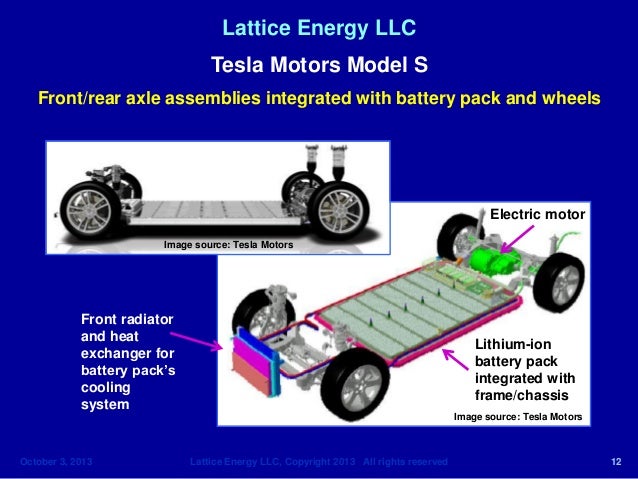 |
| Lattice Energy LLC slide |
But we calculate with maximum power, the losses are increased exponentially.
Max power
|
81,0 kW
| |
Voltage
|
50,0 V
|
60,0 V
|
Current
|
1620 A
|
1350 A
|
Internal resistance
|
0,03 Ω
| |
Internal losses
|
78,7 kW
|
54,6 kW
|
97,20%
|
67,50%
| |
Each pack is compound by several cells
Cell element
|
3,7 V
|
12,00 Ah
|
0,25 kg
|
30,00 mΩ
|
Cells is connected in serial and parallel circuit, and we can calculate more aproximation to real datas.
Cell pack
|
Series cells
|
14 S
|
17 S
|
Parallel cells
|
135 P
|
113 P
|
|
Num cells
|
1890 Cells
|
1921 Cells
|
|
Weight pack
|
480,38 kg
|
488,25 kg
|
|
Voltaje pack
|
51,8 V
|
62,9 V
|
|
Capacity pack
|
1620 Ah
|
1356 Ah
|
|
Ampere pak
|
1620 A
|
1356 A
|
|
Energy pack
|
302,10 MJ
|
307,05 MJ
|
|
Max Range pack
|
775 kms
|
788 kms
|
|
Power 1hour
|
83,92 kWh
|
85,29 kWh
|
|
Internal R Pack
|
3,11 mΩ
|
4,51 mΩ
|
|
Internal loses Max range
|
136 W
|
134 W
|
|
1,26%
|
1,24%
|
||
Internal loses Max power
|
8.165 W
|
8.299 W
|
|
9,73%
|
9,73%
|
We can see that the datas improve respect de last calculus, and efficiency is near 10%
Infrastructures problems
The other problems is civil installations, the electrical instalations for private use (homes).
The regulations expose mandatory near of 10kW instalations but the electrical services is not sizing for this power in all house. The Electrical Companies apply a simultaneity factors where, all consumers don't use together the max power. (this factor is important due to efficiency, if don't use near 100% of capacity, the efficiency is less)
Normally this simultaneity factor is near to 50%, and the service for electrical installations is for 5kW per house. Therefore the time to recharge is increased.
Recharge time
|
9kW
|
9h 19,4min
|
9h 28,6min
|
5kW
|
16h 37,3min
|
17h 54,2min
|
One solution for this problem is a Tesla Powerwall, for example where, it is charging all day and it provide the fast charge to car, when we need, like a power bank for a PED, or like a hidroelectrical dam. The problem is in each charge point need similar power that batteries car. Therefore the double batteries one in car and other in power bank (remember 760kg in lithium or 3 tonnes in lead-acid bateries).
World Lithium Reserve
This current estimate totals 28.4 billion kilograms Li, for one billion cars in the world, therefore is 28.4kg per each car, there fore this source (now mainly material for batteries), it dont have future.
Now is development other batteries technologies like Fuel cell, but now is expensive and need more development.
The future is electric car, however you dont await in next years. Maybe, the next decade.


